
The Evolution of Adobe Bricks: Experimentation in Form, Fiber, and Light
by Celine Ramjit
Adobe bricks have been used for thousands of years across cultures and climates as one of humanity’s oldest building techniques. Made primarily from earth, water, and fiber, adobe represents a building tradition deeply connected to local landscapes, climate responsiveness, and communal knowledge. Today, Adobe continues to evolve through experimentation with new materials, techniques, and applications that respond to contemporary environmental and creative needs.
At the core of adobe construction is simplicity: clay-rich soil is combined with aggregates such as sand and reinforced with natural fibers to reduce cracking and improve tensile strength. The mixture is molded into bricks and dried naturally in the sun before being used for walls, ovens, benches, and architectural structures. The resulting material is breathable, thermally massive, repairable, and biodegradable.

Our recent explorations with Adobe focus on expanding both the structural and artistic potential of the material through experimentation with alternative fibers, recycled materials, light integration, geometric molds and creative techniques blending traditional and contemporary evolution.
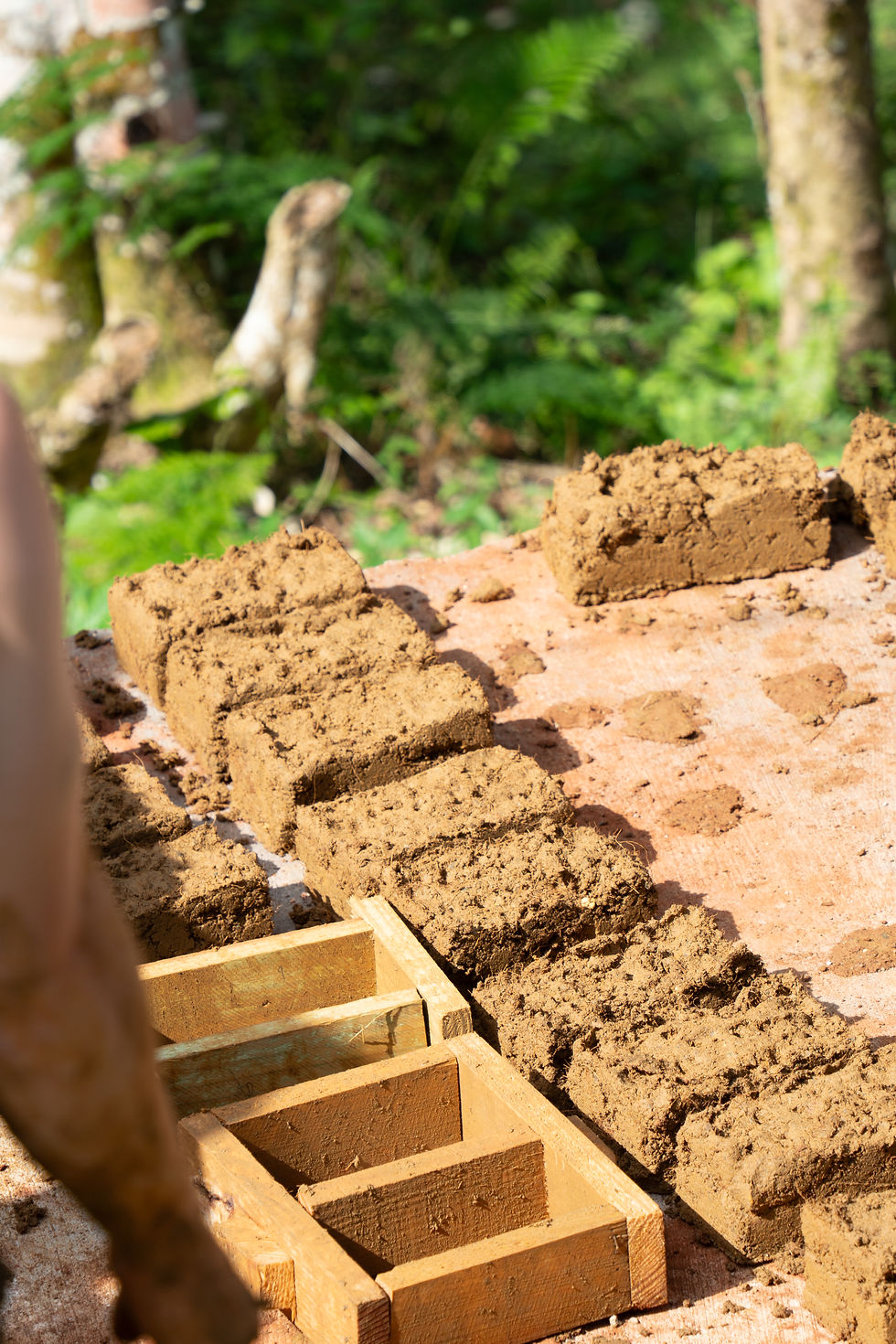
Terrestrial Fibers Experimentation in Adobe
Natural fibers play an essential role in adobe construction by helping bind the material to reduce shrinkage and cracking during drying. Traditional straw remains widely used, but our work has explored the use of regionally available fibers that may offer different structural and aesthetic qualities.
Fibers we have currently tested include:
Coconut Coir
Lemongrass
Rice Straw
Vetiver
African Star Grass
Saw- Shavings/ Sawdust
We found that each fiber introduces unique characteristics to the adobe mix:
Coconut coir provides durability and tensile reinforcement.
Lemongrass contributes fine fibrous structure and aromatic qualities during mixing.
Rice straw offers lightweight reinforcement commonly found in traditional earthen systems.
Vetiver contributes dense leaves with strong binding potential.
African Star Grass introduces fine organic texture and flexibility.
Saw-Shavings/ Sawdust reduces the overall density and is lightweight.
Through testing, we were able to observe how each material influences:
cracking behavior
drying time
cohesion
workability
texture
weight and density
These experiments help build a broader understanding of how locally available organic materials can strengthen earthen construction while remaining ecologically grounded.
Examples of different fibers; (left) Saw- Shavings, (middle) African Star Grass, (right) Rice Straw
Handmade Mud Bricks and Rocket Stoves
Adobe wall systems continue to serve as both an ancient technology and a platform for contemporary natural building innovation. We have taken these handmade mud bricks that are often used for architectural construction and utilized it in the creation of a collection of rocket stoves. These stoves were constructed using earthen bricks formed in molds from similar clay-based mixes (clay, sand and fiber) and assembled into efficient combustion systems.
Rocket stoves are designed to burn small amounts of fuel efficiently by creating a highly insulated combustion chamber that promotes complete burning of wood and directs heat where it is needed. Adobe works particularly well in these systems because it can withstand repeated heating and cooling cycles while storing and radiating heat over time.
The integration of adobe into rocket stove systems reflects a broader approach to regenerative design—one that utilizes local materials, reduces dependence on industrial products, and creates durable systems that can be maintained with simple tools and community knowledge.
The use of handmade mud bricks in rocket stove construction demonstrates the versatility of adobe and earthen materials beyond architecture alone. The thermal qualities of clay make it especially suitable for heat-retaining applications such as cooking systems, ovens, and fire structures.
Rocket Stove at Durga's Den made from Adobes of Clay, Sand and Coconut Coir and finished in a Clay-Base Plaster (Jamaica)
Rocket Stove at Wa Samaki made from Adobes of Clay, Sand and Rice Straw and finished in a Lime-Based Plaster (Trinidad)
Developing Half-Brick Adobe Molds
As part of our ongoing experimentation with adobe brick systems, half-brick molds have also been developed to improve efficiency and ease during construction. In traditional bricklaying and earthen construction, half bricks are frequently needed for staggered bonding patterns, corners, edges, and structural alignment. These pieces are often cut manually from full-sized bricks, which can be time-consuming and lead to material breakage or waste.
By creating dedicated half-brick adobe molds, the process becomes more streamlined and intentional. The molds allow half bricks to be produced directly during the brick-making stage, resulting in:
easier stacking and bonding patterns
improved structural alignment
reduced material waste
faster building processes
cleaner and more consistent construction details

These experiments are part of a broader effort to refine adobe construction techniques while maintaining the handmade and adaptable nature of earthen building. Even small innovations in mold design can significantly improve workflow, efficiency, and material use within natural construction practices.

Exploring Geometry: Alternative Adobe Brick Forms
While rectangular adobe bricks remain the most common form in earthen construction, exploring alternative geometries opens new possibilities for design, construction, and material efficiency. By experimenting with shapes such as squares, triangles, octagons, and custom geometric molds, we can investigate how form influences the way bricks are stacked, how it influences curved or radial construction techniques, modular and interlocking systems, load distribution and bonding, and creating patterns within a wall system. These explorations challenge conventional approaches to adobe construction and invite new ways of thinking about earth as both a structural and creative building material.

Different shapes also influence how the adobe dries, shrinks, and handles stress. Through this process, we can observe:
cracking behavior around edges and corners
ease of demolding
stacking stability
material efficiency
integration with bottle bricks and other hybrid systems

The experimentation with non-traditional adobe molds expands the creative language of earthen building while continuing to use simple, low-impact materials and handmade processes. It opens possibilities for adobe to move beyond conventional forms and into more sculptural, adaptive, and contemporary applications.

Adobe Bottle Bricks
We love a Bottle Wall as much as we love Adobe, so naturally the question arose: what if the bottle became part of the adobe brick itself? The idea was simple but exciting—combine the thermal mass and natural beauty of adobe with the light-transmitting qualities of glass bottles. From that curiosity, the concept of the Adobe Bottle Brick was born.
What began as a playful experiment quickly became an exploration of how recycled glass and earthen materials could work together within a single building unit. By embedding bottles directly into adobe brick molds and packing clay mixtures around them, we created hybrid bricks that could potentially bring light, color, and texture into earthen wall systems while maintaining the benefits of adobe construction.
The experimentation is ongoing, with adjustments being made to bottle placement, mold sizing, and fiber composition to improve structural integrity and drying performance.
Octagonal Adobe Bottle Brick made from a mix of Clay, Lime, Sand and Rice Straw
Standard Adobe Bottle Brick made from a mix of Clay, Lime, Sand and Rice Straw
Earth Building Immersion Experiments — August 2025 Adobe Brick Making Class
During the Earth Building Immersion in August 2025, students engaged in an intensive and playful hands-on exploration of adobe and earthen construction through collaborative experimentation, material testing, and mold development. The immersion created a space where traditional earth building knowledge could intersect with contemporary ideas around design, sustainability, material reuse, and creative construction techniques.
Everyone was encouraged to move beyond standardized adobe recipes and instead approach earth as an adaptable and experimental building medium. Using combinations of locally sourced clay, sand, natural fibers, and organic aggregates, students created a wide range of test bricks while documenting the behavior and characteristics of each mix.
Natural Building Immersion August 2025; Creating cob mixes and applying into Adobe Molds
The experiments focused on understanding how varying material ratios affected:
structural integrity
drying time
cracking and shrinkage
density and weight
texture and surface finish
workability during molding and application
Natural fibers that were introduced into the mixes:
Rice Straw
Vetiver
Sawdust
Wood chips
A variety of aggregates of different particle sizes:
Red sand
White sand
Gravel
Sharp Sand
Stone
Fine sand mixed with stone
And two binders; Clay and Limestone.

Each fiber and aggregate produced different results within the adobe matrix, allowing students to observe how organic materials contribute to stability, tensile strength, flexibility, insulation, and crack resistance.
Adobe Experiments made by Students of August 2025 Natural Building Immersion
In addition to material experimentation, students explored the relationship between form and construction by creating and testing different mold geometries. While traditional adobe bricks are typically rectangular, the immersion encouraged experimentation with alternative forms such as:
squares
triangles
octagons
Even circles and hand shaped brick forms
These explorations opened discussions around:
interlocking systems
alternative bonding patterns
sculptural architecture
modular wall systems
the aesthetics of earthen construction
The process transformed brick-making from a purely functional task into an act of design experimentation and material research.
A significant component of the immersion was the integration of recycled materials into earthen systems. As part of his final project, Curtis developed a series of custom geometric molds, referred to as “geomolds,” alongside experimental bottle brick systems. His project explored how glass bottles could be embedded directly into adobe brick molds to create hybrid adobe bottle bricks capable of introducing light, transparency, and texture into earthen walls.
The bottle brick experiments investigated:
the structural relationship between clay and glass
methods of stabilizing bottles within adobe forms
how light interacts through translucent wall systems
opportunities for material reuse in natural building
aesthetic and architectural possibilities of embedded bottle construction
Curtis presenting his final project on his 'Geo Molds' and adobe experiments
By combining geometric molds with recycled glass elements, the project challenged conventional ideas of what adobe construction can look like. The resulting experiments blurred the line between structural building material and sculptural architectural features.
The Earth Building Immersion ultimately became both a learning environment and a collaborative research space — one where we explored earth not only as a traditional material, but as a living medium capable of adaptation, innovation, and contemporary application. Through experimentation, observation, and hands-on making, students contributed to an evolving body of knowledge around regenerative and ecologically responsive building practices.
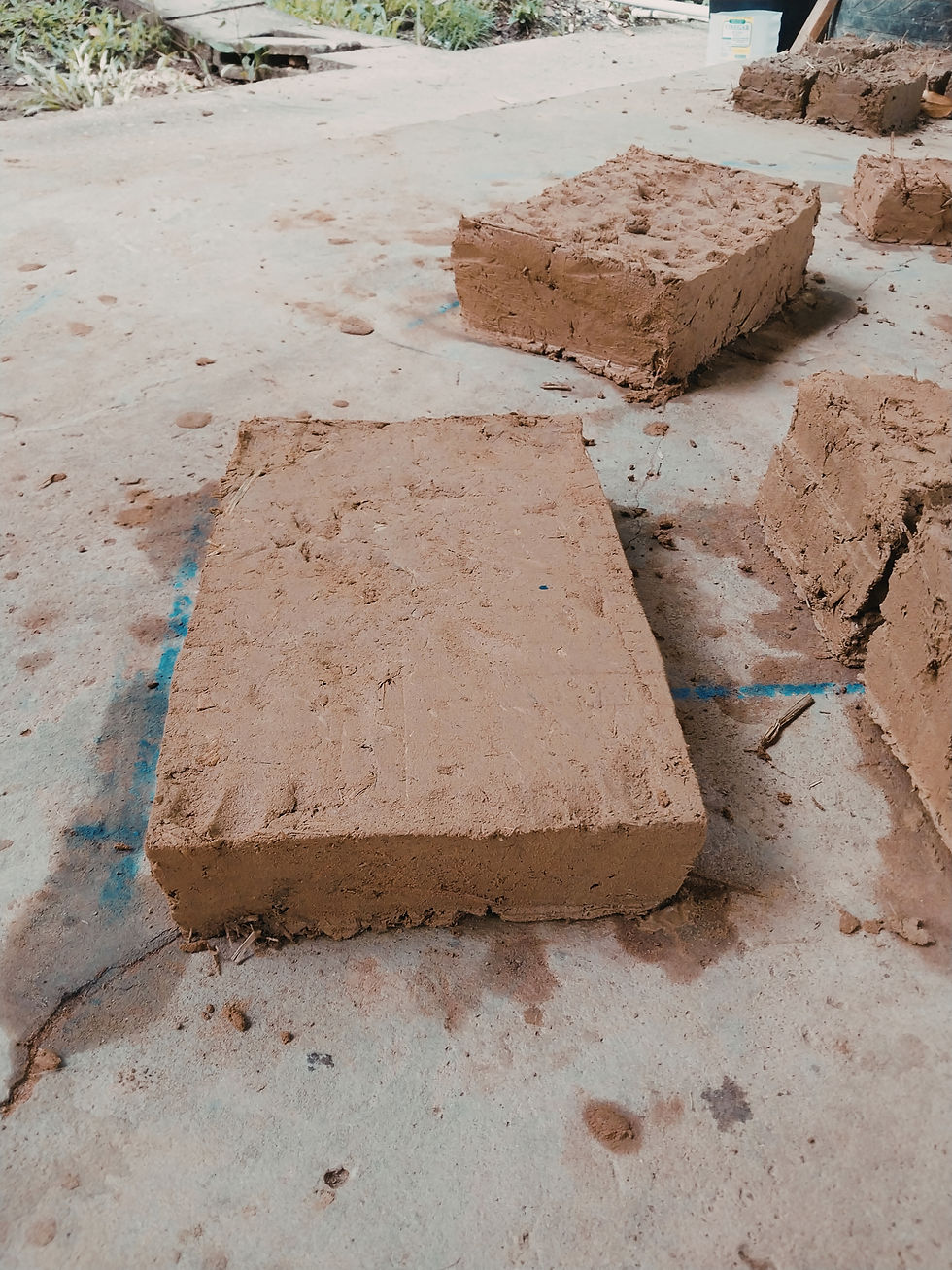
Coastal Fibers: Experimenting with Seamoss and Sargassum in Adobe
Our final area of experimentation has a focus on the use of marine biomass as fiber reinforcement in adobe brick production. We have been testing both seamoss and sargassum within clay-based mixes to explore how these coastal materials interact, bind, and dry when incorporated into earthen construction.
Seamoss is a sea vegetable—an aquatic plant-like organism that absorbs nutrients directly from seawater. It is commonly found attached to rocks in shallow coastal waters or washed ashore in smaller quantities and has recently been introduced into our adobe brick experiments as a potential natural fiber additive within earthen construction mixes. Naturally rich in minerals such as iodine, calcium, magnesium, and potassium; it is fibrous in structure when dried and gel-like when soaked in water. It absorbs and retains moisture easily and is organic and biodegradable.
Eucheuma Cottonii (left) fresh vs (right) dried
Traditionally, adobe relies on plant-based fibers such as straw to improve tensile strength and act as rebar within the structure. These experiments remain exploratory and process-driven, with seamoss offering a different kind of organic material—marine-based rather than terrestrial—bringing new variables into the behavior of clay systems. The dried seamoss is incorporated into clay, sand, and water mixtures and then formed into bricks using standard adobe molding techniques. These trials are focused on understanding how seamoss interacts with earth during mixing, drying, and curing. We have experimented with Eucheuma Cottonii and Gracilaria two species of seamoss commonly found.

Sargassum, a floating brown seaweed increasingly washing onto Caribbean and Atlantic coastlines, presents both an environmental challenge and a potential material opportunity within natural building practices. In recent years, unusually large blooms of sargassum continue to accumulate along shorelines; when it washes ashore and decomposes, sargassum can produce strong odors and release gases such as hydrogen sulfide. These massive accumulations can impact:
beaches and tourism
marine ecosystems
fishing communities
coastal water quality
However researchers, builders, and artists have begun exploring ways to transform this abundant biomass into regenerative construction materials.
Within natural building, sargassum may be integrated as an organic fiber additive in earthen systems like:
adobe bricks
cob mixes
earthen plasters
insulation mixes
Sargassum has the potential to provide reinforcement within clay-based mixes by helping reduce cracking, increase cohesion, and introduce lightweight fibrous structure to the material.
One of the major benefits of integrating sargassum into natural building is its abundance. In many coastal regions, the material is often treated as waste after washing ashore in massive quantities. Reimagining it as a building resource creates opportunities for:
reducing coastal waste accumulation
transforming environmental excess into usable materials
encouraging localized and regenerative building systems
reducing dependence on industrial construction products
creating new material economies rooted in ecological adaptation
Experimentation with sargassum also opens conversations around regionally responsive architecture — building systems that emerge directly from the materials and ecological conditions present within a place. Rather than importing industrial materials, communities may begin working with what naturally surrounds them, even materials once considered problematic.
There are still challenges to address, same as in using seamoss, particularly concerning salt content, long-term durability, and material processing. Ongoing experimentation is needed to understand how sargassum behaves over time within clay systems and how it can best be treated or combined with other materials. However, these explorations point toward a future where natural building becomes increasingly adaptive, experimental, and deeply connected to local ecosystems.
Integrating sargassum into earthen construction is not simply about creating new bricks — it represents a shift in perspective. It asks how environmental challenges can become material resources, how waste can become architecture, and how contemporary natural building can evolve through ecological responsiveness, creativity, and regeneration.
Thus, in collaboration with our friends from Kee Farms, we created a series of experimental bricks using sargassum, clay, and sand in varying ratios. These experiments were designed to observe how the material behaves during mixing, drying, and curing, while testing the potential of sargassum as a reinforcing organic fiber within earthen systems.

Evolving the Tradition
Adobe is not a static material or just a historical artifact — it is a living practice that continues to adapt through experimentation, collaboration, and ecological awareness. By integrating recycled glass, testing new fibers, different mold shapes, and applying adobe to functional systems like rocket stoves, we continue expanding the possibilities of earthen construction.
Our explorations demonstrate how traditional techniques can evolve while remaining rooted in principles of sustainability, accessibility, and relationship to place. Through our continued experimentation and documentation, adobe remains both an ancient technology and a material for future regenerative building practices.
Sun-Dried Adobe Bricks


Comments